


Mobility

Performance in 2025
Mobility saw mixed performance in 2025. While ongoing large-scale long-term projects supported our revenues, order intake softened due to procurement delays and capacity constraints in several key markets.
In response, the GBA optimized its global resource allocation, targeted alternative business models, and leveraged its growing digital capabilities. The mobility market remained strong in our key focus areas of North America, Germany, and the Netherlands where we saw good growth, albeit constrained by resource limitations, whilst we saw significant weakness in the UK and Australia.
In North America, we saw the positive impact of the mobilization of the large projects we won in 2024, and consequent surge in backlog, resulting in revenue in 2025. These large programs in the United States and Canada continued to drive steady delivery, and the business won several major contracts. In Germany, the acquisition of WSP Infrastructure Engineering GmbH doubled our presence in the German rail market (see box-out for more information) positioning us well to benefit from the strong investment program Deutsche Bahn is rolling out.
In the UK we saw a material revenue decline as result of the winding down of the HS2 rail project, which had accounted for a large volume of Mobility’s work in the UK. Although market demand was not strong enough to fully offset this decline, the team won a significant project with National Highways for consultancy services across many of our core competencies. These include asset operation, maintenance, assurance, and performance, and statistics and transport modelling. Excluding the impact of HS2, the UK business grew 5%.
In Australia, the conclusion of several large highway projects, and absence of new large scale infrastructure projects, negatively impacted our performance. Both countries did increase their respective backlogs in 2025.
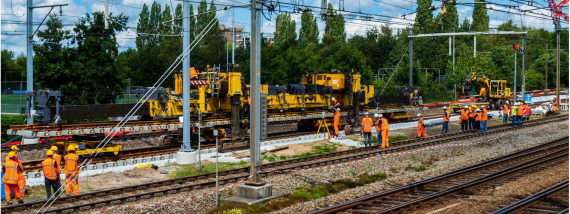
The April 2025 acquisition of WSP Infrastructure Engineering GmbH
The acquisition of Germany-based rail engineering specialist WSP Infrastructure Engineering GmbH means Arcadis is now in a strong position to grow further in this key European rail infrastructure market. The 160-person strong company already held critical pre-qualifications for framework agreements with Deutsche Bahn.
As these complement our existing rail-related activities in Germany, we expect to unlock significant new revenue opportunities through a combination of more streamlined project delivery, global collaboration, and the capacity and expertise in Arcadis’ Global Excellence Centers.
Global resource optimization
Global resource optimization, including with the GECs, helped us to overcome capacity challenges in 2025 and maintain delivery continuity in North America. For example, the Fraser River Tunnel project in Vancouver, Canada, began with a three-person Mobility team on the ground. Support then arrived from colleagues in the UK (expertise in advisory program management), France (tunneling), and Belgium and Australia (civil works and road design). Mobilizing a team in the UK helped us bid successfully to extend Arcadis’ role in the Hudson Tunnel Project. And UK teams were instrumental in winning a project to design a transportation technology blueprint for the Georgia Department of Transportation, and to design a replacement for the I-10 Calcasieu Bridge, in Louisiana. Global work-sharing provides a means to fully leverage our technical know-how and to balance international client demand across the Mobility GBA.
Increased focus on design-build and partnerships
The increase in global work sharing also supported a shift in our North American portfolio away from traditional cost-plus advisory work with limited design services. It enabled a more integrated design-build strategy tailored to large public-private partnership concessions and major contractors. Design-build projects are characterized by long procurement cycles, extensive technical knowledge, and the ability to mobilize multidisciplinary teams rapidly when projects move into delivery.
Expanding data-driven solutions
A significant number of Mobility’s clients are involved in integrated management systems (IMS). These digitally enabled mobility systems use data to manage traffic flow or rail movements. As an advisory service, IMS puts us at both the front (design) and back end (operation) of all these projects.
We strengthened our digital capabilities in 2025 through the further integration into our IMS services of several advanced design and consultancy tools for natural and built assets. We now use these tools in tolling, asset health, and safety. In May 2025, a partnership with Michelin Mobility Intelligence was launched. One of the services offered to clients is to visualize and assess risks across entire road corridors; massive datasets provide a "clearer, real-time view" of road safety compared to traditional, scattered collision reports.
In 2025, we established four value propositions for our integrated digital-mobility tools:
-
Public-private partnerships (P3s) for roads, using public and private data to support operations, maintenance, and asset performance. Including providing traffic-management data for tolling solutions.
-
Digital-technology blueprints. These help clients respond to myriad technological innovations on a considered rather than ad hoc basis.
-
Deploying analytics to assess road health, bridge health, and road safety.
-
Our enterprise data analytics (EDA) capability, which supports portfolio-management decisions by applying integrated data across large mobility and infrastructure programs.
In 2025 we took steps to secure a bigger position in growth markets such as design-build, German railways, multimodal hubs, and data-based services.
Heather Polinsky, Global President for Resilience and Mobility


